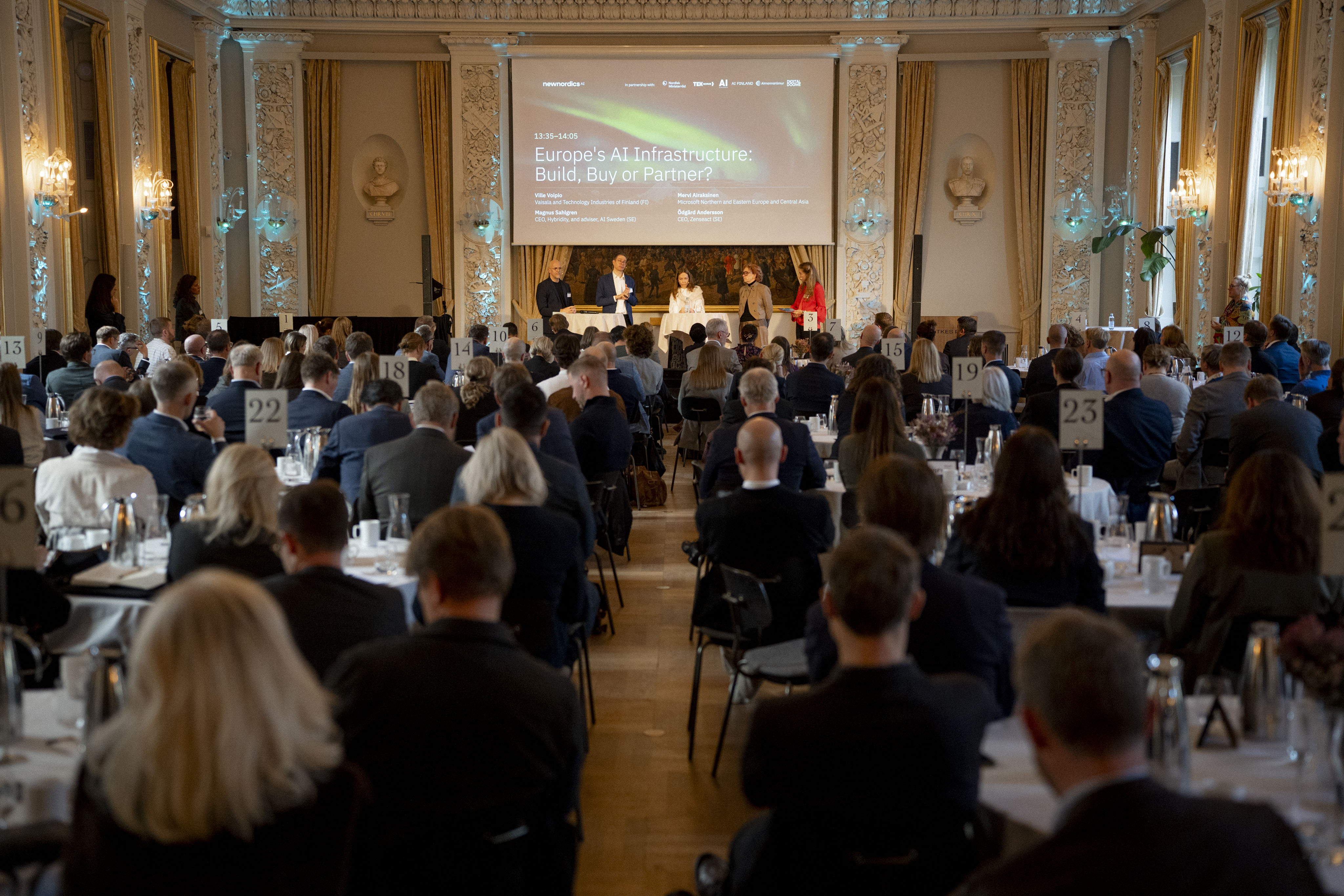
Participants at the New Nordics AI High-Level Forum in Copenhagen have today pointed at a set of recommendations for stronger Nordic-Baltic cooperation on artificial intelligence.
The recommendations were presented this afternoon to ministers and government representatives from across the Nordic and Baltic region as concrete input to the next phase of political cooperation on AI.
The purpose of the recommendations is to strengthen the region’s competitiveness, resilience and ability to develop and deploy AI at scale:
Four of the 14 recommendations:
- Validated healthcare AI should work across the whole region
Today every hospital and region has to document the same solution from scratch. With common requirements for evidence and validation, solutions that already work, such as stroke diagnostics and breast cancer screening, could reach patients in all eight countries much sooner. - Make the Nordic-Baltic region one home market for AI companies
If AI rules were interpreted the same way and testbeds and talent were open across borders, companies would have a market of 33 million people from day one. That makes it easier to scale and attract international investors, and it needs no new institutions. - Make AI a core part of teacher education
Teachers face AI in the classroom every day, but they don’t have the time, training or guidance to adapt how they teach and assess. Building AI into both initial teacher education and professional development would help schools use the technology in a way that is sound in their subjects and critical. - Speak with one voice on EU data centre rules
The EU is now setting a rating scheme and minimum standards for data centres, and the Nordic-Baltic region starts from a strong position with renewable power and waste heat reuse. Joint positions would let the region shape rules that both attract investment and require energy efficiency.
Eight Executive Roundtables
The recommendations were developed across eight Executive Roundtables bringing together senior representatives from government, business, research, the public sector and civil society. The discussions covered data, work, education, trust, technological resilience, healthcare, energy infrastructure and the conditions for scaling Nordic-Baltic AI companies.
The recommendations will now feed into the continued political dialogue on AI across the Nordic and Baltic region and help shape the next phase of cooperation. The aim is to turn shared priorities into concrete cross-border initiatives and make better use of the region’s combined strengths.
The Nordic and Baltic countries have a long tradition of solving shared challenges together. Artificial intelligence is no exception. Today's recommendations show both the strength of our common ambitions and the opportunities ahead for even closer Nordic-Baltic cooperation.” says Karen Ellemann, Secretary General of the Nordic Council of Ministers.